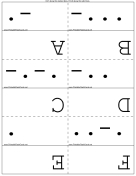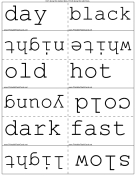

Gene structures, adaptive behavior, and evolutionary traits are covered in these biology flash cards.
There are 20 flash cards in this set (4 pages to print.)
To use:
1. Print out the cards.
2. Cut along the dashed lines.
3. Fold along the solid lines.


Sample flash cards in this set:


| Questions | Answers |
|---|---|
| Analogous structure | Structures that do not have a common evolutionary origin but are similar in function. |
| Artificial selection | Process of breeding organisms with specific traits in order to produce offspring with those same traits. |
| Camouflage | Structural adaptation that enables a species to blend with their surroundings |
| Homologous structure | Structures with common evolutionary origins; can be similar in arrangement, function or both. |
| Mimicry | Structural adaptation evolved in some species where one species resembles another. |
| Natural selection | Mechanism for change in populations; occurs when organisms survive, reproduce and pass their traits on. |
| Vestigial structure | Structures that has no function in a present-day organism but was probably useful to an ancestor. |
| Allelic frequency | Percentage of any allele in a population's gene pool. |
| Directional selection | Natural selection that favors individual with one extreme of a trait. |
| Disruptive selection | Natural selection that favors both extreme variations of a trait. |
| Gene pool | All of the alleles in a populations genes. |
| Genetic drift | Alteration of allelic frequencies in a population by chance events. |
| Genetic equilibrium | Condition in which the frequency of alleles in a population remains the same over generations. |
| Variation | Differences with in a species that is provided by mutations and sexual reproduction. |
| Speciation | A process of evolution of new species that occurs when members of similar populations no longer interbreed to produce fertile offspring. |
| Stabilizing selection | Natural selection that favors the average individuals in a population. |
| Adaptation | Inherited features that make a species more suited to survive and reproduce in its environment. |
| Adaptive radiation | Divergent evolution in which ancestral species evolve into an array of species to fit a number of diverse habitats. |
| Evolution | The gradual accumulation of adaptations over time. |
| Over production | More offspring are born than can survive to reproduce. |