A set of flash cards that cover different terms used in composing and writing music
There are 19 flash cards in this set (4 pages to print.)
To use:
1. Print out the cards.
2. Cut along the dashed lines.
3. Fold along the solid lines.


Sample flash cards in this set:


| Questions | Answers |
|---|---|
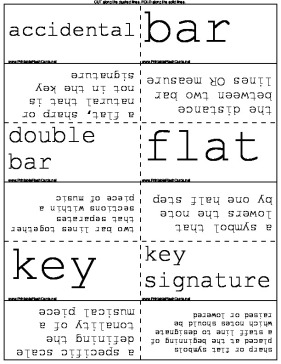
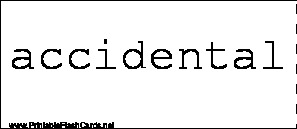
| accidental | a flat, sharp or natural that is not in the key signature |
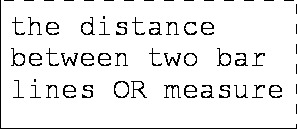
| bar | the distance between two bar lines OR measure |
| double bar | two bar lines together that separates sections within a piece of music |
| flat | a symbol that lowers the note by one half step |
| key | a specific scale defining the tonality of a musical piece |
| key signature | sharp or flat symbols placed at the beginning of a staff line to designate which notes should be raised or lowered |
| natural | cancels out a sharp or flat |
| sharp | raises a note one half step |
| common time | another term for 4/4 meter |
| compound time | a time signature in which the beat units are divisible by three, such as 6/8, 9/8 and 12/8 |
| eighth note | a musical note having one-eighth the time value of a whole note |
| half note | a musical note having half the time value of a whole note |
| meter | how beats and accents are grouped within a measure |
| quarter note | a note that has one quarter the time value of a whole note |
| rest | a beat or beats of a measured silence |
| tie | a curved line that joins two notes |
| time signature | the numbers written on a staff to indicate the meter. The top number tells how many beats are in each measure, and the bottom number tells which kind of note gets a single beat. |
| treble clef | a symbol that wraps around the G line at the beginning of the staff |
| whole note | a note that is equal to four quarter notes or two half notes |