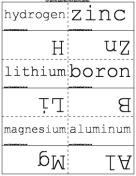
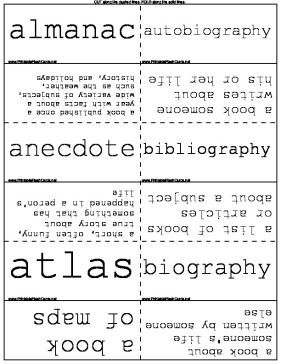
Non-fiction prose types are listed in these literature flash cards
There are 25 flash cards in this set (5 pages to print.)
To use:
1. Print out the cards.
2. Cut along the dashed lines.
3. Fold along the solid lines.


Sample flash cards in this set:

| Questions | Answers |
|---|---|
| almanac | a book published once a year with facts about a wide variety of subjects, such as the weather, history, and holidays |
| autobiography | a book someone writes about his or her life |
| anecdote | a short, often funny, true story about something that has happened in a peron's life |
| bibliography | a list of books or articles about a subject |
| atlas | a book of maps |
| biography | a book about someone's life written by someone else |
| chronological | events arranged in the order in which they happened |
| diagram | a drawing or plan that explains how something happens or works |
| fact | a statement that can be proved true and is backed up by data or evidence |
| glossary | an alphabetical list of words and definitions that help you understand important terms in a book |
| index | an alphabetical list that shows you where to find specific information in a book |
| infographic | an illustration used to show information or data |
| informational text | text that gives the reader facts about topics in the sciences, social studies, or the arts. Newspapers, magazines, and textbooks contain informational text |
| interview | a conversation in which someone asks another person questions about themselves, their work, and their ideas |
| journal | a diary in which a writer jots down his or her thoughts, feelings, and experiences |
| memoir | a book or essay that someone writes about his or her memories |
| narrative nonfiction | true events written in story form, often including characters, dialog, and plot |
| opinion | a statement that tells what someoone thinks about a topic. It cannot be proved true or false |
| persuasive essay | a text in which the author tries to get readers to accept his or her viewpoint by giving reasons. Also known as opinion writing |
| procedure | a set of instructions on how to complete a task or solve a problem |
| source | a person, book, document, or website that provides information or evidence |
| statistic | a fact in the form of a number or percent |
| quotation | a group of words taken from a text or speech and repeated by someone other than the original quthor or speaker |
| research | to study or learn new things about a topic, usually by reading a lot about it or by doing experiments |
| table of contents | a list of topics in a nonfiction text that tells you how information in that text is organized |