Artists who work with clay, wood or marble can learn about making sculptures
There are 17 flash cards in this set (3 pages to print.)
To use:
1. Print out the cards.
2. Cut along the dashed lines.
3. Fold along the solid lines.


Sample flash cards in this set:


| Questions | Answers |
|---|---|
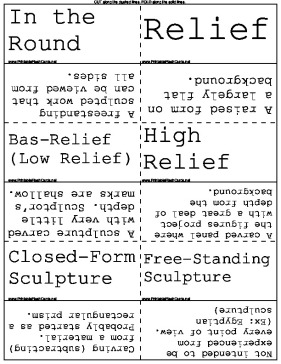
| In the Round | A freestanding sculpted work that can be viewed from all sides. |
| Relief | A raised form on a largely flat background. |
| Bas-Relief (Low Relief) | A sculpture carved with very little depth. Sculptor's marks are shallow. |
| High Relief | A carved panel where the figures project with a great deal of depth from the background. |
| Closed-Form Sculpture | Carving (subtracting) from a material. Probably started as a rectangular prism. |
| Free-Standing Sculpture | Not intended to be experienced from every point of view. (Ex: Egyptian sculpture) |
| Artifact | An object made by a person. |
| Found Object | An object found by an artist and presented, with litle or no alteration, as part of a work or as a finished work of art in itself. |
| Kinetic Sculpture | Sculpture that moves. |
| Methods of Sculpture | Carving, modeling, casting, earthworks, construction, and readymades. |
| Carving | Subtractive method of sculpture. |
| Modeling | Additive process that usually uses clay and wax. An armature is used with clay. |
| Casting | Additive process that involves adding a liquid or pliable material to a mold. Lost-Wax Process. |
| Earthworks | Additive process on a large scale. Monumental sculptures that used the Earth's surface as material. |
| Construction | Additive process. Duh. Considered relatively new. |
| Readymades | An everyday object presented as a work of art. An artifact or a found object. |
| Installation Sculpture | Involves the construction of a space or the assembly of objects to create an environment. Space is used as the fundamental element. |